As a part of strategic planning and master plan studies, the Valparaiso City Utilities (VCU) Board of Directors initiated engineering designs in 2022 in order to finalize construction plans for major improvements at the City’s
water and wastewater facilities.
Plans for capital projects were finalized and prioritized,
including the costs of these projects, and the net effect on utility rates. Supporting documents can be found at https://valparaisoutilities.org/166/Rates-Deposits .
The goal is to continue to provide safe, reliable, and uninterrupted services
at a competitive cost to our community while supporting responsible
growth and maintaining compliance with environmental requirements.
The VCU Board of DIrectors approved the plan on March 12, 2024. The timeline for presentation, public comments, discussion and vote is presented below.
- March 25, 2024 – 4:45 until 6:00 PM Open house in City Council chambers. Documents supporting the plan and impact to rates will be available for review. City utility staff will be on hand to field questions. This is NOT a presentation, it is an open information gathering session and the public is welcome to walk in at any time during the 75 minute open house to review the plans and ask questions.
- March 25, 2024 – 6 PM City council meeting begins. On the agenda is the Public Presentation of the project plan, proposed bond issue and proposed rate increase. There is no action on this agenda item during this meeting. There will be an opportunity to ask questions immediately after the presentation and during the public comment portion of meeting. The presentation will last approximately 45 minutes.
- April 8, 2024 6 PM City council meeting begins. On the agenda will be the 1st reading for the bond and rate ordinances. I have asked Council President Cotton to request a public hearing during this meeting so the public will have an opportunity to ask additional questions prior to the 2nd reading. I urge residents to attend this meeting and pose any remaining questions and hear responses to previously posed questions.
- April 22, 2024 6 PM City council meeting begins. On the agenda will be the 2nd reading for the bond and rate ordinances and a public hearing will be held during this meeting to provide for public comments and questions. Also on the agenda will be the vote for the bond and rate ordinances.
I have formulated a list of questions and hope this list will spark additional questions from the public. Steve Poulos, Executive Director, Valparaiso City Services, provided responses.
- Are these projects identified in the utilities strategic/capital plan? When was the plan prepared?
RESPONSE: Yes. The 2018-2022 VCU Strategic Plan that provides a 5-year road map was approved by the Valparaiso City
Utilities (VCU) Board of Directors in October of 2017 and identified the need to replace aging infrastructure
“Implement Long Term Strategies for the Water department” which includes new wells to replace aging wells
and an aging water distribution infrastructure replacement plan.
In addition to water needs, the plan also identified the imminent need (“Implement Long Term Strategies for
the Water Reclamation Department) for the wastewater treatment plant which includes assessing the current
state of equipment, determining future assets, and investigating potential process changes/additions. This
section also identifies the continuance of an aging infrastructure replacement plan.
Subsequently, after the master plans were completed, the VCU Board of Directors proceeded with design
contracts for the appropriate construction for both the water and wastewater construction plansin May of 2022
& September of 2022.
2. I understand the portion of the projects dedicated to the water projects was previously discussed publicly at the time bond anticipation notes were approved. Are there any differences in the project plan presented in 2022 versus the plan submitted today?
RESPONSE: Ordinance No. 29-2022 as
approved by the City Council
identified improvements for an
amount not to exceed $23
million. As identified in the
presentation slide the
differences are as follows:
The Backwash Recycling System
at Flint Lake was removed in lieu
of upgrading the (SCADA) system
which provides monitoring and
data acquisition control
system. The total bond issue is
now at $17.5 million versus $23 million.
3. Explain why the timeline for project start up is compressed.
RESPONSE: Per the plan timeline above, the generational projects have been outlined and discussed at VCU Board meetings
for a number of years. Additionally, at the beginning of the 2024 calendar year and to assist in educating new
council members, we provided the appropriate tours of the affected facilities. In January 2024 the City was 45-
60 days from receiving final bid numbers on the planned projects and indicative interest rates from the State
Revolving Fund (SRF), so rather than present a hypothetical project cost and rate impact we elected to wait until
we had final numbers, which we received on March 4, 2024, and then conducted in depth discussions with the
City Administration, VCU Board of Directors and City Council members where we discussed in detail the final
rate impact, not an estimated impact. The remainder of the calendar is per SRF requirements as their fiscal year
ends on June 30, 2024, therefore if the City chooses to accept SRF’s financing package that includes subsidized
interest rates, we are required to close on these low interest bonds by the end of June 2024.
As a requirement, the City cannot close on the bonds without having the rate adjustments in place to pay off
the bonds, therefore those two actions go hand in glove. Consequently, the timeline was adjusted as far as we
could to accommodate as many outreach meetings as possible and will not close on the bonds until June 20,
2024, therefore with only 10 days to spare. While the timeline may feel compressed because we are providing
so much information, the timeline is essentially out of our control.
4. What was the approval process to obtain low interest loans? How do the low interest loans impact the rates?
RESPONSE: The approval process to obtain the low interest financing from the State Revolving Fund (SRF) is as follows:
a. Submit a Preliminary Engineering Report, Asset Management Plan and Application to SRF
by April 1, 2023.
b. In late Summer 2023, SRF provides their project priority list ranking all applicants. There
were over 50 applicants for water and over 120 applicants for sewer projects. Initially,
Valparaiso was ranked outside of the fundable range, meaning we would not receive the
approximate 2% financing.
c. In the August 2023 time frame SRF came back to VCU and determined that VCU has been moved
up and both water and sewer projects were now the last community in the fundable range thus we
were eligible for approximate 2% financing on up to $10 Million in water loans and $25 Million in
sewer loans.
d. In fall 2024 we were asked by SRF when we would have construction costs in hand on the
projects so SRF could start planning on when our projects would be ready to close. We
advised them early 2024.
e. Before the City would be allowed to close on the financing with SRF the City would need to
complete the following items:
i.) Adopt a bond ordinance legally authorizing the issuance of the debt with SRF (the City
Council approved the water projects when the Bond Anticipation Note was approved in
January of 2023) and a plan to do this for sewer with first reading on April 8, 2024 and final
vote on April 22,2024.
ii.) Have all projects bid and final costs in hand (Accomplished this in March 2024)
iii.) Have water and sewer rates adopted that support the repayment of the bonds (the plan is
to complete this in April 2024).
iv.) Submit the packet of information to SRF for review, including an accounting report showing
the new rate adjustments to support the project and a due diligence packet of information
pertaining to the utilities (Planned for May 2024).
The low interest loans save our rate payers material dollars versus if we were to finance these projects on our
own, even with our great AA- credit rating. We estimate the savings from SRF to be approximately $7 Million in
interest payments on the sewer project, which equates to over 5% savings on the rates or approximately $4 per
month. For water the savings are estimated at $3 Million which equates to 5% savings on rates or $2 per
month. Therefore, in total, we are estimated to save approximately $10 Million in interest cost and an average
residential customer approximately $6 per month on their bill which approximately equates to 1 entire phase
rate increase eliminated due to the SRF financing
5. Can the projects be completed in stages to extend out the rate increase beyond 5 years?
RESPONSE: All the identified “generational” projects are to provide the following:
a. Replacing aging systems (35-60+) years of age.
b. Continue to meet our environmental obligations as mandated by IDEM/EPA.
c. Improve efficiency in day-to-day operations.
d. Protect the health and safety of our community.
While these are high dollar bond projects, please be mindful that the projects that are identified were assessed
years ago with a plan in place. The construction timeline is 24 months due to supply chain challenges and the
size of the project, which is not uncommon. The only difference is the delayed wait for equipment which pushes
out substantial completion of the project. While these projects are a “portion” of our critical facilities, pushing
out the term for construction raises the risk profile for potential failure, compliance, and cost.
Things to consider:
a. Staging the projects to save rate payers money is understood, however it will have the exact opposite
effect.
b. Every project includes mobilization and demobilization components, meaning the contractor mobilizing
his team and equipment on site, starting the project, finalizing the project, restoration and moving his
team and equipment off site.
c. Splitting a project into stages will add cost by creating additional mobilization and demobilization
occurrences.
d. Due to the market circumstances (price fluctuations and supply chain), contractor bids can only be held
for a specific amount of time therefore staging these projects does not guarantee today’s costs.
Therefore, the utility would need to come back to the Board and Council again when we were ready for
future stages and bid those projects.
e. The question should be raised as well “will these projects be cheaper a year from now, two years from
now, etc.?” Based on the professionals who operate in this field every day they are advising us that the
answer to that is unequivocally no.
f. In speaking with our consulting engineers, they provided that project construction costs have increased
approximately 17 % the past 3 years, and they estimate those costs will continue to increase in the
future.
g. The SRF financing package we have successfully procured with subsidized interest rates is only good
through June 30, 2024.
h. If the City decides to remove projects out of that current financing now and delay them to future years,
there is no guarantee Valparaiso will receive this subsidized interest rate again.
i. Given we were originally outside of the SRF fundable range initially and with the volume of applicants
due to available funding, we do not recommend taking that risk for our community.
j. Further, staging these projects will trigger multiple bond financings (one for each stage of project) which
results in incurring additional legal and accounting fees to issue the bonds multiple times, which
ultimately results in more cost to our rate payers.
While we can appreciate the thought that staging projects may lower the burden on our rate payers because it
spreads things out, this would be “kicking the can down the road” and adding more cost to the project,
ultimately resulting in a higher bill for our constituents in the end.
6. Are we tapping into Lake Michigan water at this time? What are the plans and is any of the funding set aside in this project for blending Lake Michigan water into the existing Valparaiso water supply?
RESPONSE: Not at this time, however, please be advised that our team has been working with Indiana American Water for
approximately one year to identify the following:
a. Potential connection points throughout the Valparaiso water grid.
b. Determine if the City qualifies for Lake Michigan water due to the Great Lakes Compact and if our case
would need to be brought before the Great Lakes Commission for final approval.
c. High level costs for not only a pipe connection but improvements required by Indiana American Water
to provide sustainable supplemental water.
d. Discussion on water quality effect to the system with IDEM due to differing disinfection additives by
both utilities.
Now that Indiana American Water has recently finalized their rate case, high level estimates will be developed
as far as wholesale costs and capital needs.
7. Are there any current options for folks to action who are on a fixed income and need some relief on their monthly utility bill?
RESPONSE: Not as part of this rate adjustment proposal. However, since the Valparaiso rate adjustments are phased out
over the next five years, the Utility will recommend a study in 2024 to determine the best course of action for
affordability as rates will continue to increase as part of these rate adjustments and in the future. Per our
consultation with legal counsel, there may be limited options to provide relief to a certain class of customers.
Also be advised that the following link on the VCU website provides customers a menu of resources for
assistance at https://valparaisoutilities.org/541/Community-Assistance-Program.
Additional questions and responses (Q1-Q3 below)
Q1: You explained the footprint of the sanitary plant is not changing and the upgrades will result in
increased capacity and more efficient operations. What type of monitoring is needed to insure as
Valparaiso’s population grows, the capacity of the plant can accommodate this growth and what is
the population projection which will create the need to increase the footprint, i.e. plant expansion
Q1 Response
The facility monitors daily flows and pollutant loadings for all required design parameters as documented
within the Monthly Report of Operations and Discharge Monitoring Report which is submitted monthly
to the Indiana Department of Environmental Management (IDEM). Additionally, as I discussed in the
public presentation on March 25, 2024, per Section 327 IAC 4-1-3 – Early warning system:
“Whenever, in the determination of the commissioner, a semipublic facility or POTW has reached
or is approaching ninety percent (90%) of its hydraulic or organic design capacity, the
commissioner shall notify the semipublic facility or POTW that it may be necessary, because of
such condition, to impose a sewer connection ban if action is not taken by the semipublic facility
or POTW to accommodate additional flow or loading.”
In addition to population growth there are various reasons why a plant upgrade would be required to
create the need to increase the footprint or i.e “plant expansion”.
- Increased Standards- driven by regulators (IDEM/EPA) that may place stricter discharge limits which
would require improvements. During Valparaiso’s pre-design discussions with IDEM our team and
consulting engineers discussed any imminent environmental standards that our design should
consider as we finalize design and construction plans for the projects and approval by IDEM. This
does not guarantee that these increased standards may not change during the lifecycle of the
proposed improvements. - Aged Equipment/Technology – which has been presented in detail based on the current age of
process units, proposed upgrades to these process units to maintain environmental compliance and
service to the community. Additionally, technology continues to change thus providing opportunities
to process more flow and loading within an existing footprint. - Expansion of Treatment Plant Capacity – due to a combination of rising population, business or
industry which creates higher volumes of wastewater and loading.
Valparaiso through their data intelligence and design successfully submitted and received an approved
IDEM capacity rating increase from 8 Million Gallons per Day (MGD) to 10 MGD. Based on this capacity
increase, Valparaiso’s uncommitted reserve capacity (once construction is complete) will increase an
additional 2 MGD without constructing additional facilities thus now having a total 3.3 MGD in
uncommitted reserve capacity for the community at no additional rate payer cost.
Strictly from a “population” perspective, an additional 3.3 MGD of uncommitted reserve capacity is equal
to more than 10,000 residential units.
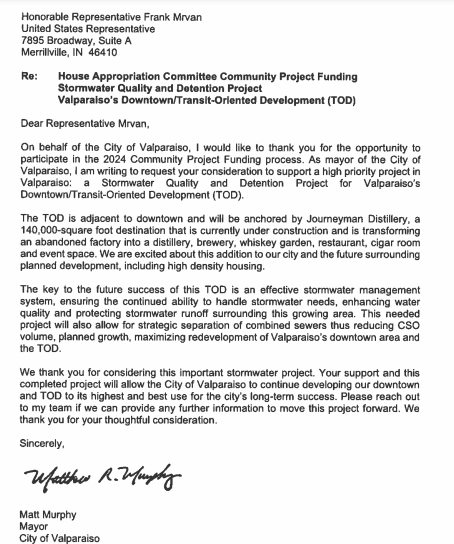
Q2 The city of Valparaiso has been awarded $959,062 from the Federal Community Project Funding
grant. This funding will assist with the Stormwater Quality and Detention Project to address combined
sewers through sewer separation projects. You explained the funding request was made several years
ago. Please provide the specifics for this project and whether any portion of the project is included in
the PAYG Capital Plan or Infrastructure Plan.
Q2 Response Please see the attached most recent community project funding submission as of March 10, 2023 that
provides the details of the submission.
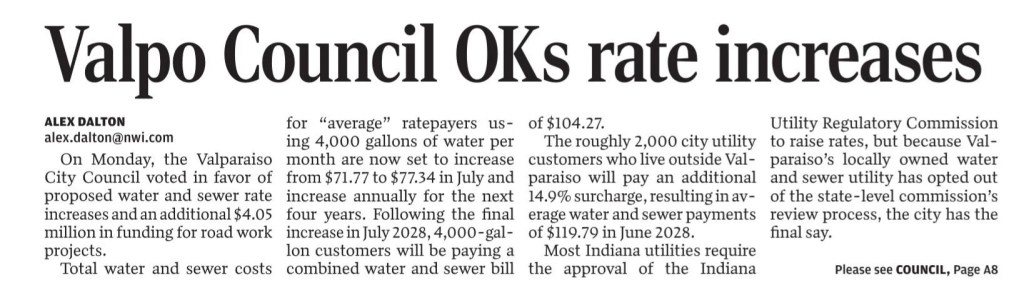
Q3 I suspect you have been questioned since the article appeared in the Times regarding the Portage
wastewater expansion project. Both Valparaiso and Portage received SRF funds for projects, yet
Portage did not raise customer rates. I understand the projects vary greatly in cost (5-fold), but
Portage boasts of not raising rates on a $12 million-dollar project. Unfortunately, both articles
appeared on the same page of the newspaper. Further, did Valparaiso receive credits from the
Inflation Reduction Act when solar panels were installed at the treatment plant and is the city eligible
for any further credits for energy efficiency upgrades as identified in the project plan? I recall you
mentioning the project energy efficient savings is @ $500,000.
Q3 response
No, I have not been questioned however please be advised of the following:
- Every community has infrastructure needs, specific growth patterns, community makeup,
financial health, and regulatory obligations. - Per the City of Portage’sslide rate case presentation dated February 16, 2016 (see attached slides
from their website), the City of Portage placed a $0.50 per year increase on all residential
customers, higher increases for multi units and a 3% increase per year on all non-residential (i.e.
commercial and industrial) customers. - These yearly increases result in increases from 2016 through 2028 for Portage of 19% for
residential customers and 43% for commercial/industrial customers. Note: (2028 is equal to the
last year of Valparaiso’s proposed rate increase) - As far as boasting about not raising rates for these projects, for clarity, the article in the tribune
also stated that now that this project is underway, “the city is moving rapidly toward its next
major sewer infrastructure project.” Their Sanitary board will be approving this week “money for
a new ultraviolet radiation system for the plant, bringing it up to modern standards, and $6
million to reline pipes, as well as adding a lift station and sewer lines to the north side.” I was
advised by their representative that the next SRF sewer application is for an additional $31 million
dollars for improvements in 2025 and they will need to adjust sewer rates accordingly. - As you mentioned, Valparaiso’s wastewater project is 5-fold the size of Portage’s 2024 project
and our overall rate adjustment compares similarly to the impact their commercial/industrial
customer base will experience for a $12 million dollar project. - Further, I have not been able to fully ascertain how the City of Portage is paying for the debt
related to this project. I have made inquiries, but I do not have final confirmation as of today.
 BARBARA DOMER: Valparaiso City Council District 3
Leave a comment